 Windy City Gridiron
The year was 1948, and the Chicago Bears were having kicking troubles. So they tapped a source of athletic greatness that all NFL teams dip into now and again: semi-pro ball in Racine, Wisconsin.
And thus the legend of NFL placekicking pioneer Fred Venturelli was born.
“Fred Venturelli, Racine football and softball star, signed a contract to play with the Chicago Bears for the 1948 season,” reported The Journal Times out of Racine, Aug. 30, 1948. “The signing of Venturelli by George Halas, owner-coach of the Chicago Bears, is regarded in the National Football League circles as a precedent breaking move because the Racine athlete was offered a contract only because of his kicking ability.”
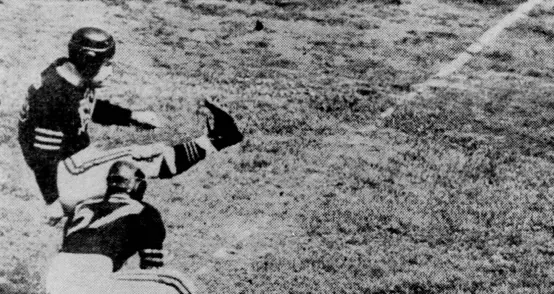
Welcome to the story of the oldest rookie in Chicago Bears history, 31-year-old Fred Venturelli, the NFL’s kinda, sorta first specialist placekicker — and the only game he played in his NFL career.
During the first three decades of NFL football, players had to be ready to play all three phases of the game. Most did. A team had its “starting 11,” and substitution rules were limited: entering the 1940s, when a player subbed out, he could not sub back in until the next quarter. These were the so-called “60-Minute Men,” versatile players valued first for their offense, then for either their all-around abilities or whatever they did that was elite, whether on defense or special teams.
Chief among those specialized elite players was a placekicking powerhouse for the Bears named Jack Manders. His nickname: Automatic Jack. Manders was a running back who was so exceptional as a kicker that in 1934, the UPI added an unprecedented 12th man to their All Pro team just to give Manders a spot.
Manders’s final game was the 1940 NFL championship, AKA 73-0, which showed the Bears as a placekicking-by-committee club, seven players attempting extra points. After Manders, quarterback Bob Snyder and tackle Lee Artoe became our top kickers, followed by left guard Pete Gudauskas, who hit a league-best 36 PATs in 1944, missing just one, and then going a perfect 27-27 in 1945. But the team attempted a grand total of zero field goals in ‘44, and only three in ‘45.
We weren’t alone in our field goal troubles. Midway through ‘43, the UPI published a widely syndicated piece on the problem; one Illinois paper ran it under the headline “FIELD GOALS THING OF PAST.”
“Not since 1940,” the author wrote, “when ‘Automatic’ Manders of the Chicago Bears completed eight seasons of football with a record total of 40 field goals to his credit has the art of the three-pointer been familiar in football.”
NFL teams hit 40% of their field goals in 1940; in 1943, they made just over 23%.
The Bears’ field goal problem saw a brief reprieve in the post-war title season of 1946, with halfback Frank “The Rhode Island Thunderbolt”...