 Hogs Haven
There are seasons in the NFL when the tape becomes an indictment — an unflinching, unvarnished documentation of structural flaws, personnel gaps, and schematic imbalances that no amount of weekly optimism can gloss over.
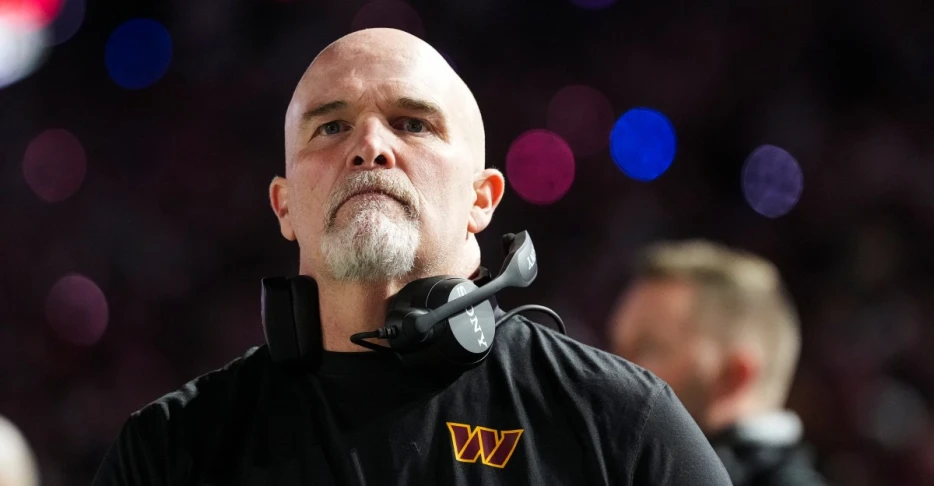
For Washington, the 2025 campaign has been precisely that: a year where the defense, a unit built with the intent to be rugged and adaptable, instead dissolved under the weight of injuries, failed experiments, and a talent base stretched far too thin for a system that demands cohesion. Yet in the closing weeks — after head coach Dan Quinn reclaimed defensive play-calling duties from Joe Whitt Jr. before the Miami game — something unexpected materialized. Order. Structure. And finally… a sense of direction.
What looked for months like a unit drifting without purpose now resembles something far more compelling: the fragile outline of what Quinn might forge in 2026 with the right personnel in place, and the philosophical recalibration he has begun applying across all three levels of the defense.
And as Washington enters Week 14 at 3–9, with the postseason all but mathematically extinguished and the evaluation period officially underway, this emerging blueprint provides the foundation for how Quinn may architect a full-scale defensive overhaul.
Context matters, particularly when diagnosing a season that spiraled early. Washington didn’t simply underperform defensively — they cratered.
The first half of the year was defined by coverage busts, blown assignments, edge defenders losing contain against even the most pedestrian run concepts, and a linebacker corps stretched to its breaking point in space. Injuries accelerated the decline: Will Harris early on, Deatrich Wise, Dorance Armstrong, second-round corner Trey Amos, the back end rotated through combinations no coordinator would willingly choose, and the pass rush rarely coalesced into the synchronized pressure packages Whitt’s system relies on.
The results were historically poor, both situationally and structurally. Opposing offenses pulsed with rhythm; Washington’s spacing often fractured under motion, misdirection, and layered route concepts. Whitt’s defense leaned too heavily into man-match principles without the horses at corner to withstand isolation. Too many plays felt like individual defenders trying to solve problems alone — an untenable dynamic in a system that thrives on disguised intention and synchronized movement.
It was not all effort; it was architecture.
When Quinn resumed play-calling, the shift was subtle, but profound. Washington has played more zone, but more importantly, more vision-driven zone — concepts that encourage corners and safeties to play downhill, triggering aggressively on in-breaking routes, and reducing the number of snap-to-snap one-on-one survival tests on the perimeter.
It also has masked Washington’s deficiencies.
With Bobby Wagner — still a cerebral, physical A- and B-gap defender, but no longer a functional coverage linebacker — Quinn has knitted together the middle of the field with layered zone drops, funneling crossers in to help rather than leaving Wagner exposed to space. Young players like Jordan Magee, a fast-flowing second-level defender who profiles as a hybrid weak-side/middle...