 Field Gulls
Few NFL organizations invest in player development quite like the Seattle Seahawks.
Over the years, John Schneider and the Seahawks’ personnel department have built roster depth not only through premium draft picks, but by consistently finding value in places where most teams stop looking. In a league increasingly dependent on identifying and developing raw talent, Seattle continues to search for upside beyond the seven rounds of the draft.
That’s exactly where Marvin Jones Jr. enters the picture.
He wasn’t drafted. He wasn’t one of the biggest names in the post-draft free agent market. And he certainly doesn’t arrive with the kind of college production that typically generates excitement.
Yet among Seattle’s undrafted additions, few players possess a more intriguing collection of physical tools than the former Oklahoma edge defender.
For a defense entering 2026 with veterans like DeMarcus Lawrence, Uchenna Nwosu, and Dante Fowler Jr. already occupying major roles, Jones doesn’t represent an immediate solution.
He represents something else.
A long-term developmental bet on an athlete who, at one point, looked destined to become a high draft pick.
Seattle’s challenge will be determining whether there is a better football player hiding behind the modest statistics and inconsistent production.
Because purely from a physical standpoint, there is still plenty to work with.
Marvin Jones Jr. has never been an unknown player.
The son of Marvin Jones Sr. — one of the greatest linebackers in Florida State history and the winner of both the Butkus and Lombardi Awards in the early 1990s — Jones grew up surrounded by elite football. His last name carried weight long before he stepped onto a college field.
Coming out of high school, he was considered one of the premier edge prospects in the country. A five-star recruit, Jones arrived at Georgia with enormous expectations and entered one of the most talent-rich environments in college football.
But his journey never followed the trajectory many expected.
At Georgia, he spent two seasons playing a supporting role within a roster loaded with future NFL talent. His body developed. His athletic tools remained intriguing. The opportunities, however, were limited.
He appeared in 13 games for Georgia’s national championship team in 2022 and saw a larger rotational role in 2023, but the flashes never translated into sustained production. The transfer to Florida State was supposed to be the breakout opportunity.
The numbers improved. In 2024, Jones recorded 25 tackles, six tackles for loss, and four sacks. It wasn’t a dominant season, but there were signs of progress.
Then came another move.
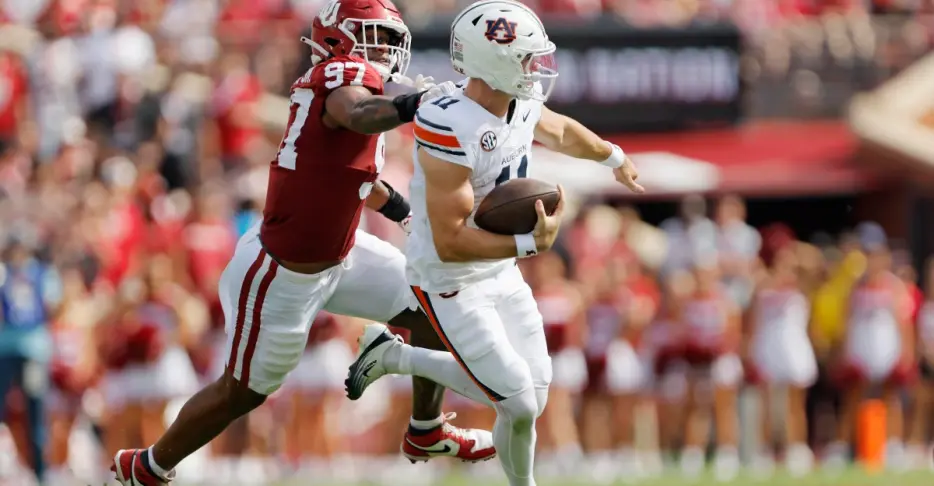
Jones transferred to Oklahoma for his final collegiate season, hoping to finally deliver the campaign that matched the hype he carried as a recruit.
Instead, he finished with 21 tackles, five tackles for loss, and two sacks.
The issue was never the flashes. The issue was turning those flashes into consistency.
By the end of the pre-draft process, many evaluators saw essentially the same player they had seen years earlier: a solid athlete with NFL-caliber size and movement...