 Field Gulls
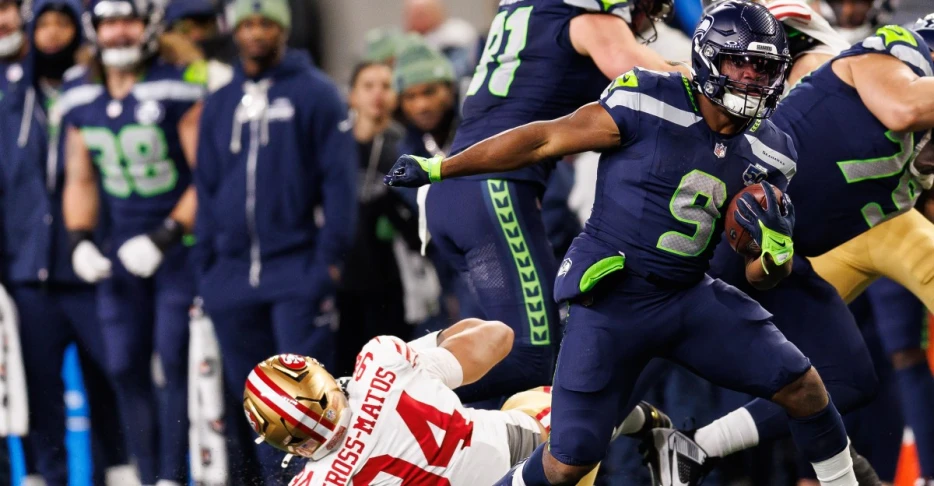
The Seattle Seahawks played their first Divisional Round game since the January 2020 loss to the Green Bay Packers, and they did so with a level of focus and execution that showed up clearly on tape. Despite a week filled with external noise and rivalry-driven narratives, Seattle delivered a dominant 41–6 victory. From an All-22 perspective, this game is a strong case study of what this defense can be when it consistently plays within structure, maintains leverage, and communicates effectively across all three levels.
More importantly, this game reinforced a central theme of the Seahawks’ postseason ceiling: the offense is the unit that will ultimately determine how far this team goes. The defense once again played at a high baseline, but unlike previous weeks, it was paired with offensive efficiency, early-down success, and explosive plays. The result was a 41-point output instead of another grind-it-out, low-scoring win.
All data used in this article comes from PFF.
From a film standpoint, the primary defensive issue was not a lack of pressure, but a failure to finish plays. Seattle consistently collapsed the pocket, won early at the point of attack, and forced Purdy off his spot. However, that pressure too often failed to translate into sacks or negative plays.
While the scoreboard never reflected danger, these breakdowns extended drives unnecessarily and allowed San Francisco to generate offense beyond what the original play design intended. Against quarterbacks who are more dangerous throwing on the move — Matthew Stafford being the most relevant upcoming example — this becomes a critical problem.
Most of the 49ers’ successful passing reps did not come from clean, on-schedule concepts. Instead, they came from second-reaction throws after Purdy escaped the pocket and forced the coverage unit to transition from pattern-match rules into scramble drill principles.
Pause the tape the moment Purdy breaks contain. Uchenna Nwosu wins cleanly off the edge, defeats the tackle’s outside hand, and has a free path to the quarterback. The issue is not rush timing, but rush lane discipline at the finish point. Nwosu overruns the depth of the pocket just enough to allow Purdy to step up and escape.
Downfield, the secondary executes at a high level. Coverage leverage is intact, routes are plastered, and spacing rules are respected. However, when the rush does not close, the coverage unit is forced to hold longer than the structure allows. This dynamic consistently punished good coverage with extended-play completions.
This has been a recurring issue throughout the season: containing mobile quarterbacks within the pocket rather than simply forcing them off their initial read. Again, Purdy escapes, resets his platform, and converts a first down in a situation where the defense has already won the rep.
Early in the game, the defensive line did not consistently control the line of scrimmage the way it had in recent matchups. The issue was not assignment integrity, but displacement. San Francisco’s offensive line was...