 Turf Show Times
When the Los Angeles Rams were set to take on the Chicago Bears in the NFC Divisional Round of the playoffs, many assumed there would be a lot of points. After all, this was a matchup between two of the best offensive minds in the NFL going head-to-head in Sean McVay and Ben Johnson.
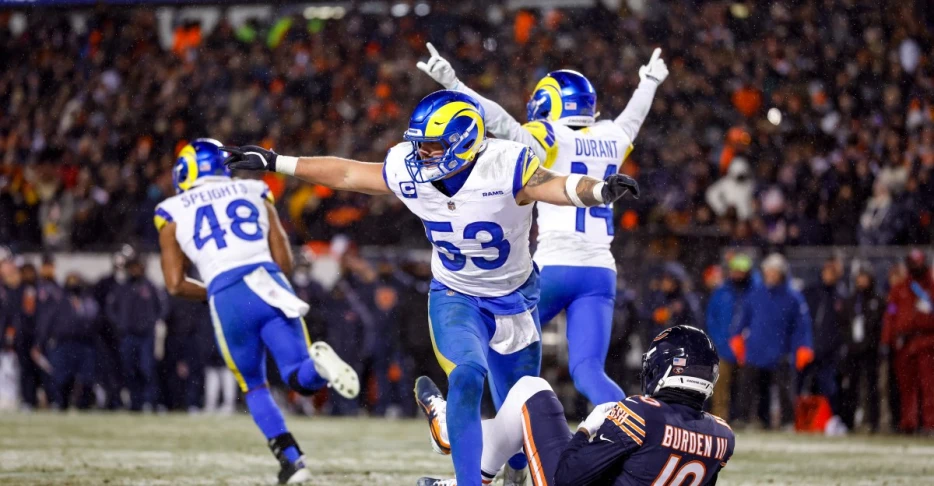
Instead, it was the two defenses leading the way. The Rams defense forced three turnovers and held the Bears to 3-for-6 on fourth down. Chicago had three empty possessions in scoring range, including two inside the 25-yard line.
It was this time last year that the Rams defense let the team down in the postseason. They allowed 285 yards rushing to the Philadelphia Eagles who went 3-for-3 in the red zone and were 4-for-5 on fourth down. Sunday against the Bears was their biggest test yet. The Bears were one of the best rushing teams in the NFL with 142.3 yards per game.
Over the offseason, the Rams built their team for this moment. They went out and signed Poona Ford to man the middle of their defensive line. They also upgraded at linebacker, moving on from Christian Rozeboom and signing Nate Landman from the Atlanta Falcons. Landman certainly has his limitations, but he was someone they could trust to be in the right place at the right time.
In the frigid cold at Soldier Field, running the ball was going to play a key role. While the Bears had 112 yards, it came on 32 carries. Kyle Monangai had a 47.9 percent rushing success rate on the season. The Rams held him to a 30.8 percent rushing success rate. D’Andre Swift had a 47.1 percent rushing success rate in the regular season. Swift was better, but even he was held to a 42.1 percent rushing success rate.
The Bears tried to wear down the Rams defense on the ground, but it was a group that continually won in the trenches. It’s fair to note that the left side of the Bears’ offensive line was less than 100 percent. However, the Rams dominated at the point of attack and the longest run by a running back was 15 yards by Monangai.
With the Bears not having the ability to find consistency on the ground, especially in short-yardage, it impacted how Johnson could call the game. The usual aggressive Johnson became more conservative. After being stopped on 4th-and-1 late in the second quarter, the Bears punted on a 4th-and-2 at midfield to start the fourth quarter. That was a very strong ‘go’ call via Ben Baldwin’s RBSDM and ESPN Analytics.
One of the more surprising decisions was when the Bears tied the game with 18 seconds left in regulation. Instead of opting to go for two and potentially win the game right there, Johnson decided to just take the extra point. After the game, Johnson noted,
“Probably what played a little bit of a factor was our goal-to-go situations hadn’t gone very clean. Our inside the...