 Turf Show Times
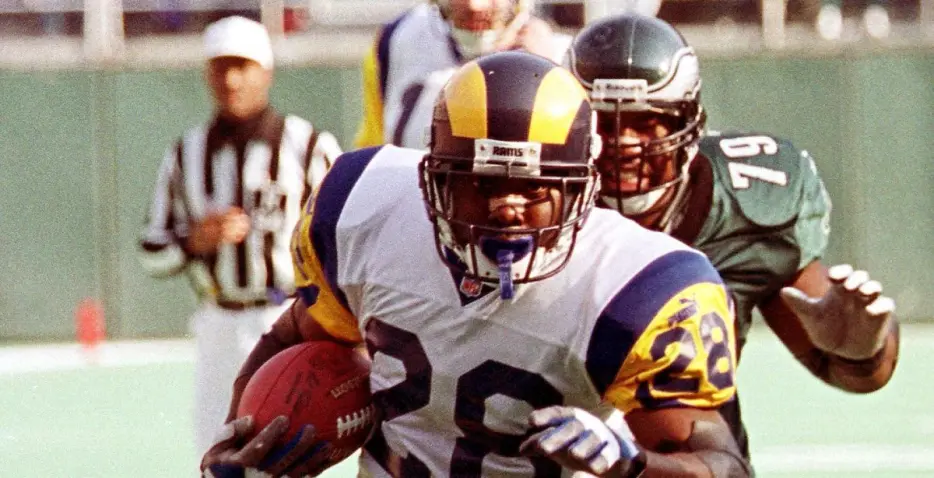
Even though it’s been 25 years since Marshall Faulk last won Offensive Player of the Year, the former Rams and Colts legend is still the most recent player to win the award in back-to-back years. Not only did he win it back-to-back, Faulk joined Earl Campbell as the only players in history to win the award three years in a row. Faulk is also the most recent non-quarterback to win the award more than once in his career.
Since then, 15 different skill players have won Offensive Player of the Year, none more than once. 25 years after he last won the award, Faulk’s ability to win the award in each of his first three seasons with the Rams showcases why he is one of the top-10 skill players in the history of the NFL.
NFL Throwback did a great career retrospective on Faulk’s accomplishments this year.
When Faulk’s relationship with the Indianapolis Colts deteriorated to the point of no return, the team told Faulk that they would try to trade him to the west coast. However, all four teams declined to make an offer. Their mistake was a huge gain for St. Louis, as the Rams were able to acquire one of the all-time legends for only a second and a fifth-round pick.
Although Faulk rushed for over 5,000 yards and nearly 3,000 receiving yards in eight seasons, coming off of a season in which he finished four in Offensive Player of the Year voting, Faulk’s days of greatness were considered numbered.
How wrong they were.
Faulk had a league-best 2,429 total yards with the Rams, a career high that he would never top. Although he only scored 12 touchdowns that season–which is good but now seems almost tame for Faulk–he beat out teammate Kurt Warner to win Offensive Player of the Year.
Of course, Warner took home MVP.
Faulk’s former quarterback in Indianapolis, Peyton Manning, finished third in MVP voting behind Warner and Faulk.
The next year, Faulk took home both MVP and Offensive Player of the Year, finishing way ahead of Donovan McNabb in both categories. The fact that Warner missed five games in 2000, only bolstered Faulk’s case for MVP.
This time, he scored 26 touchdowns.
The next year would see the return of a healthy Warner, and the quarterback won his second MVP trophy. Just as it happened in 1999, Faulk finished second in MVP and first in Offensive Player of the Year.
Faulk’s win over Warner for OPOY–23 first place votes to 22 first place votes–is still one of the closest races in NFL awards history.
But while Faulk didn’t win three MVPs and Warner didn’t win three OPOY, both made history in their own right. Warner became a two-time MVP, and Faulk became a three-time OPOY. Faulk was only 28, but by then he had worked his tail off. Over four more seasons, Faulk would only rush for 2,837 yards and added 1,428 in the air. Still...