 Windy City Gridiron
“It takes three years to grade a draft” and it’s been three years since Ryan Poles went into a draft with a 1st-round pick for the first time as a general manager for the Chicago Bears. Based on looking at every draft from 2011-2020, we know what results “should” look like by league by team, and by position. It’s fair to assume that a typical draft class will contain 60-70 “reliable starters”, players who offer at least 40 starts over their first five years. That same class will contain a number of regular contributors who do not start as often but who still appear in at least 60 games.
Teams with earlier draft priority have a better chance of finding success at nearly every level, but at a minimum a team should find two starters and two reliable contributors. Chicago had also increased its draft power by various means, and it’s worth pointing out that draft picks earned by trading away Khalil Mack, Roquan Smith, and Robert Quinn needed to pay off as well–even if they were down a different pick from the Claypool trade. Simply to get an adequate return on investment then should require at least three starters and three role-players.
Note that this is not an exercise in evaluating Ryan Poles as general manager on the whole–for this exercise he is neither being credited for the Panthers trade nor penalized for the Claypool trade. Instead, the question is whether or not, with the picks he had, he made sound selections. As such, I will be evaluating each selection on both the process (was the player taken a good value for what the team needed at the time and was he a reasonable selection in that role given what was known at the time) and how it worked out on the field, giving each half equal weight.
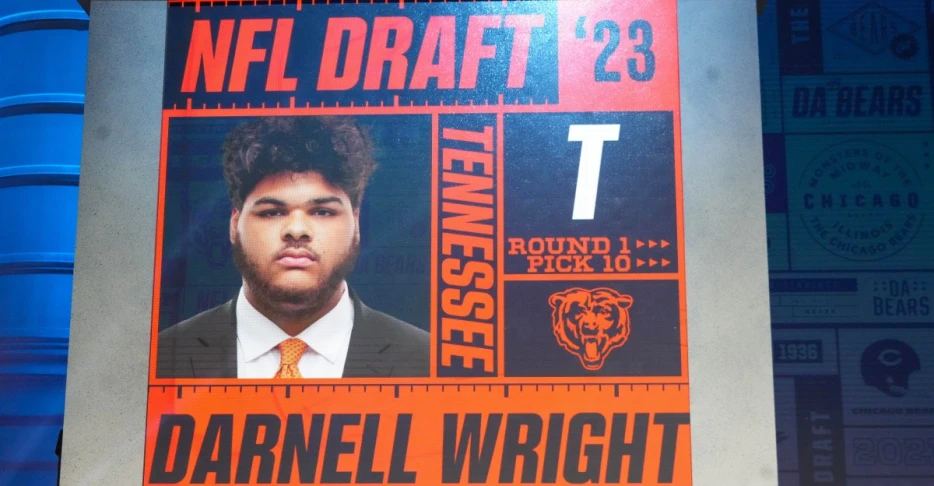
#10) Darnell Wright. Justin Fields had just been sacked on a league-worst 13% of his pass attempts, which was actually worse than the league-worst 9.67% of the prior year. Chicago needed to fix the offensive line before anything else, and using a top ten pick on a tackle was a smart move. Wright had been identified as the best offensive lineman that Will Anderson had faced, and while “draftniks” were slow to catch on, some of us spotted his talent right away. As far as process is concerned, this is easily an A.
Has it worked out? The second-team All-Pro has been an absolute anchor on the right side of the line, and most metrics agree that he has been an elite player at the position. He is one of the four best tackles in pass-blocking win rate per ESPN. Wright has played better than essentially every other tackle who would have been available to Chicago in that draft. The only caveat here is that while all of this is true, it is exactly what should be expected from a player taken with a top-ten pick. This is...