 Dawgs By Nature
The Cleveland Browns went from one offensive head coach to another. Former boss Kevin Stefanski loved his tight ends. And he kept more than his share on the roster at all times.
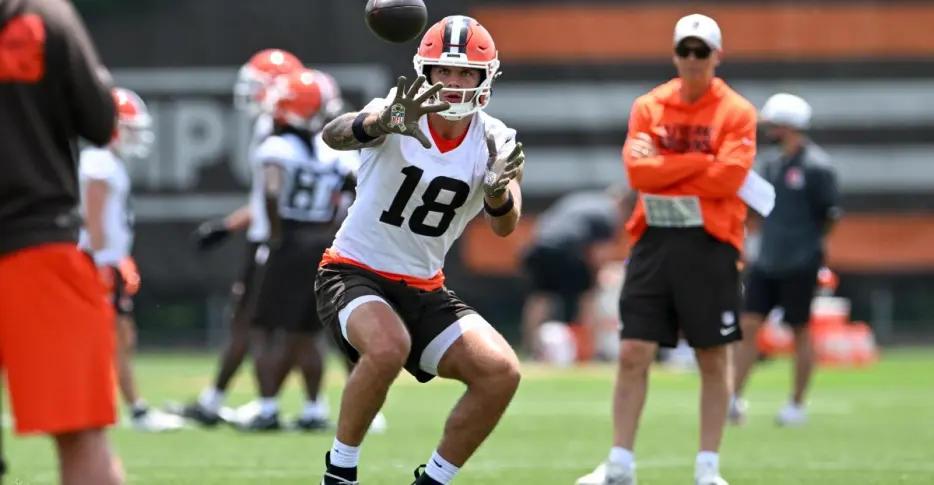
The new guy, Todd Monken, also has a fascination with tight ends. We will see how he uses them shortly. With the return of TE Harold Fannin, Cleveland’s new offense should flourish. But Fannin will need a throwing mate. Enter this year’s fifth-round draft pick, Joe Royer.
RELATED: HOW WILL CLEVELAND’S TE ROOM SHAKE OUT?
A lot of analysis of Monken’s offense has been covered in the media. Just ask Dr. Google about “Todd Monken’s offensive scheme,” which will tell you this:
“Todd Monken operates a multiple, hybrid offensive scheme that fuses Air Raid passing concepts with a power run game. His system is known as an “illusion of complexity”, relying on heavy pre-snap motion, diverse personnel groupings, and week-to-week adaptability rather than a rigid playbook.”
The honest answer is that all of the above is what he wants to accomplish. But the reality is that Monken uses what he has on the roster.
In 1982, the Miami Dolphins ranked #3 in the league in rushing. They had a successful running contraption with RB Tony Nathan and FB Andra Franklin. Head coach Don Shula built his career on being successful with the Baltimore Colts and running the ball with Lenny Moore. So, with Miami, that is how he built his offense.
But the Dolphins drafted QB Dan Marino late in the 1983 NFL draft, who was a throwing machine. Shula altered his offense from a successful rushing attack to fit his personnel with receivers Mark Duper and Mark Clayton, with Nathan now a third receiver, and Marino. Suddenly, Miami was known as an exceptional passing team. In just a few short years, Miami was 14-2-0 under Marino.
Shula adapted. Monken also adapts.
Monken prefers a two-tight-end grouping. This could involve a fullback in the absence of one tight end, but the players do the same during the game. A fullback and two tight ends are also utilized in some scenarios.
Monken spoke at this year’s Combine about about using two tight end sets:
“We were lucky enough with the Ravens to have a good number of tight ends. That puts you in a position to use that personnel group. I wouldn’t say we’re going to be a 12-personnel group of 21 and 11 until we get out there and see what we have. I think that’s our job as coaches to utilize the players that we have. We morphed a little bit last year with Isaiah Likely being hurt. And with Lamar (Jackson) being hurt a little bit more 21 than we were even 12 the year before. So, we’ll see how it goes. I do think the bigger you are, the calmer the looks.”
In a nutshell, he adapts the offense to what he has on the roster. Which means he isn’t rigid to his system...