 Field Gulls
With the College Football Playoff field officially set and Bowl Season right around the corner, draft season is quietly heating up. While many prospects will opt out of bowl games to prepare for the 2026 NFL Draft, this is still a valuable window to evaluate players — especially for teams like the Seahawks, who have very specific needs.
Seattle enters the draft with just four selections after the trade for Rashid Shaheed: one pick each in Rounds 1, 2, 3, and 6. Because of that, this list focuses on interior offensive linemen who could realistically be available across Days 1, 2, and 3, with a particular emphasis on right guard and center.
One of my favorite prospects in this class.
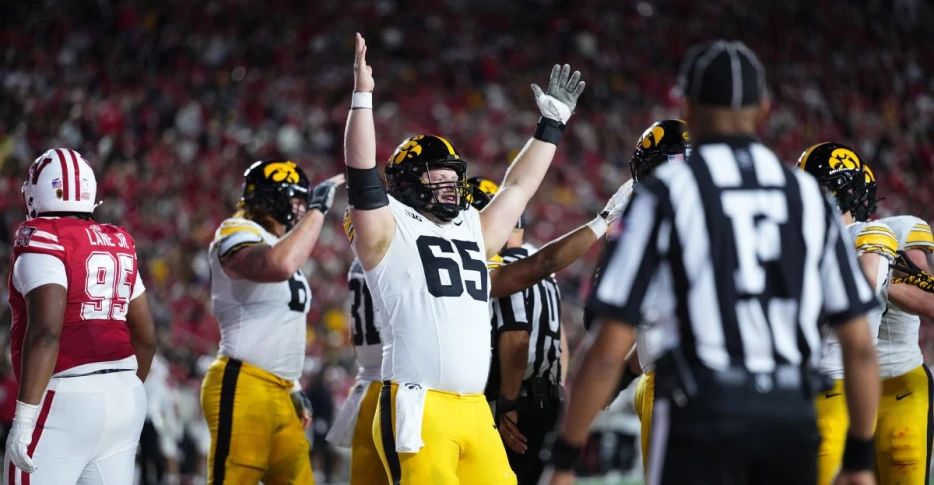
Jones is an older prospect — he’ll be 25 years old during his rookie season — and his decision to return to Iowa for another year was somewhat surprising. He originally arrived as a defensive tackle before transitioning to the offensive line, and his athletic profile is impressive. Jones has a basketball and track background, posted a 695-pound squat (an Iowa team record), and a 470-pound hang clean (second-best in program history).
He’s a highly experienced player from one of the most consistently well-coached offensive lines in college football, operating in a zone-heavy rushing attack. That same Iowa pipeline produced Tyler Linderbaum (now a free agent), Mason Richman, Connor Colby, and Dunker Gennings. That group paved the way for Kaleb Johnson’s 1,537-yard rushing season, which helped him become a third-round pick by the Steelers.
Jones consistently shows the athleticism required for reach blocks in zone schemes and excels when climbing to the second level, taking clean angles to linebackers. He also plays with good leverage against defensive linemen, making him a very clean schematic fit for Seattle’s run game.
Brailsford is an interesting evaluation when projecting fit with Klint Kubiak’s offense.
He’s undersized for a traditional center, weighing under 300 pounds — very different from the physical profiles of Jalen Sundell or Erik McCoy. That doesn’t automatically disqualify him, but it’s something worth noting. Brailsford was a standout from his very first snap at Washington, and when Kalen DeBoer took the Alabama job, Brailsford followed him.
The Aaron Brewer comparison (Dolphins) is easy to make. He’s extremely quick, light on his feet, and would function well in a zone-based system. While he struggles to displace defensive linemen and can have issues versus power due to his frame, he compensates with natural leverage and good hand usage in pass protection.
Another personal favorite on this list.
Parker is likely to transition inside to guard or center at the NFL level due to arm length limitations, but his tape is excellent. He was one of the best run-blocking offensive linemen in zone schemes this season. Parker is physical, technically refined, and a very good athlete.
There are areas to clean up in pass...